0 a 96 km/h em 2,4 segundos num SUV de 2.600 kg. Vale a pena comprar o Cayenne Coupe Electric?
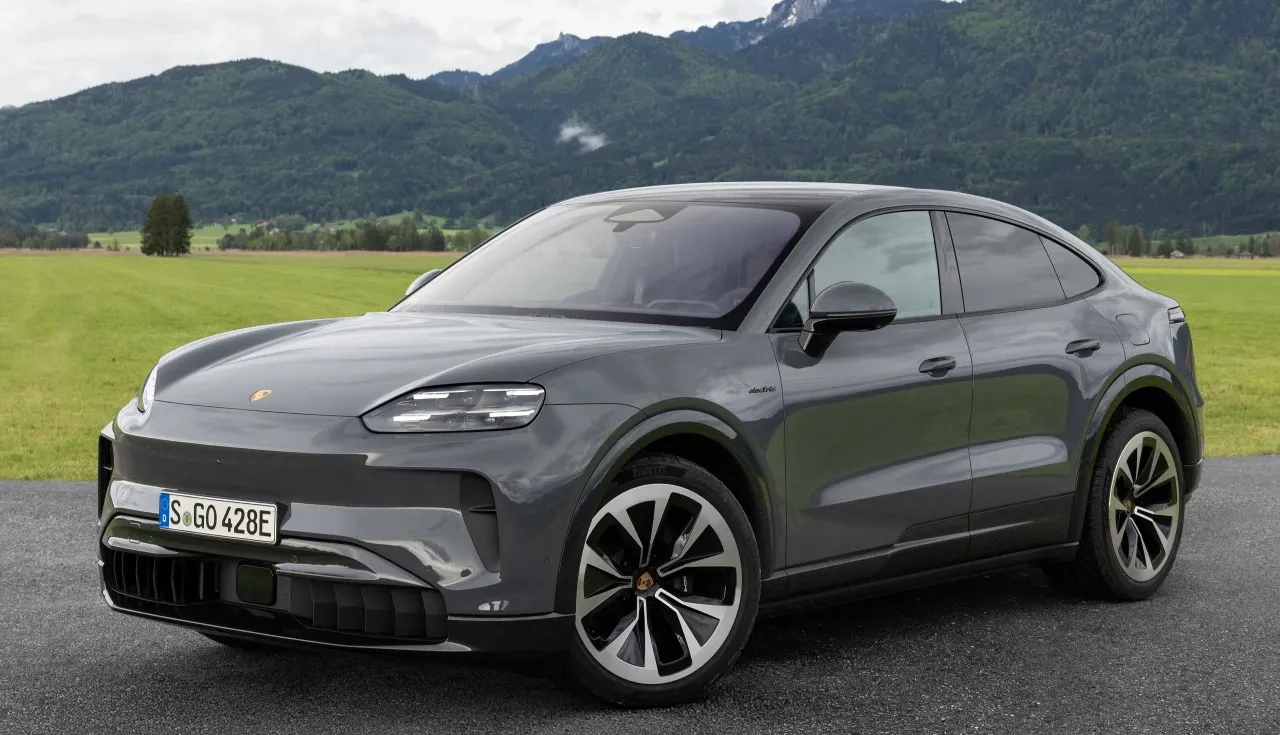
The 2027 Porsche Cayenne Coupe Electric makes 1,156 horsepower, hits 60 mph in 2.4 seconds, and starts somewhere north of $105,000. This is the most capable electric SUV Porsche has ever built — and it shows.

Por: Danniel Bittencourt
22/05/2026
2027 Porsche Cayenne Coupe Electric: The Electric SUV That Changes the Conversation
Porsche just made it official: the next Cayenne Coupe is going fully electric. And they didn’t ease into it. The Turbo variant produces 1,156 horsepower with Launch Control engaged, sprints from 0 to 60 mph in 2.4 seconds, and rides on an active suspension system that puts most sport sedans to shame.
This isn’t a conversion or a stopgap. The Cayenne Coupe Electric is built from the ground up on the PPE platform — a dedicated electric architecture developed jointly with Audi, where nothing was borrowed from an internal combustion layout. The battery placement, weight distribution, and thermal management were all engineered with electric-only operation in mind from day one.
In the US market, the Cayenne Coupe Electric goes up against the BMW iX M60 and the Mercedes-Benz EQE SUV AMG 53. But the most serious dynamic rival is the Lotus Eletre R, which matches Porsche’s obsession with chassis tuning and torque vectoring almost point for point. American deliveries are expected to begin in late 2026 as a 2027 model year vehicle.
Built to Cut Air: The Cayenne Coupe Electric’s Aggressive, Aerodynamic Shape
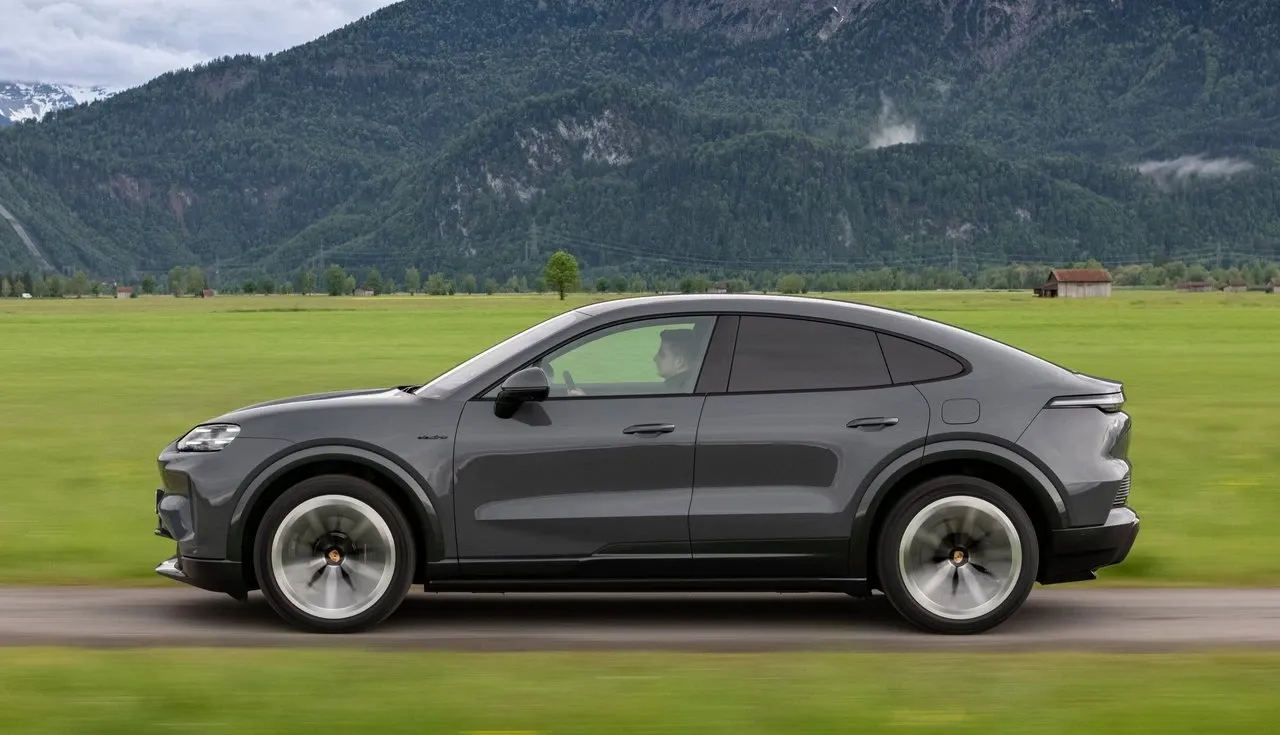
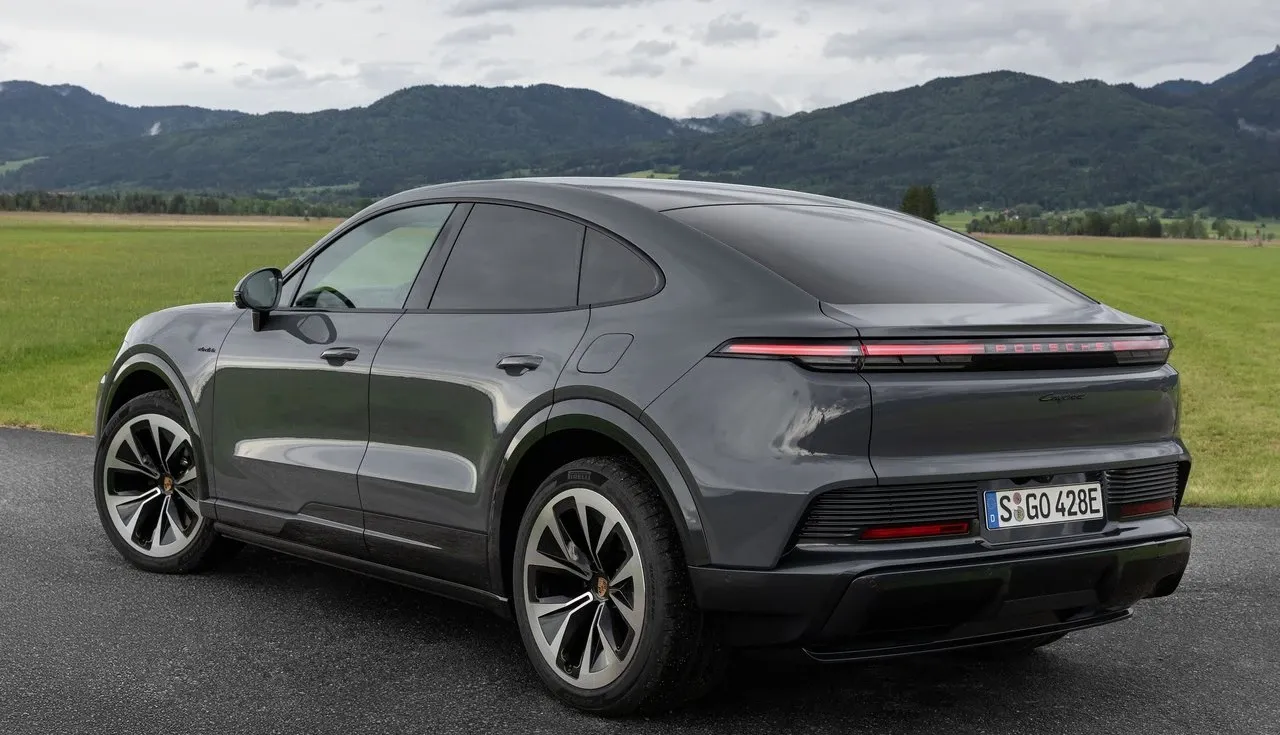
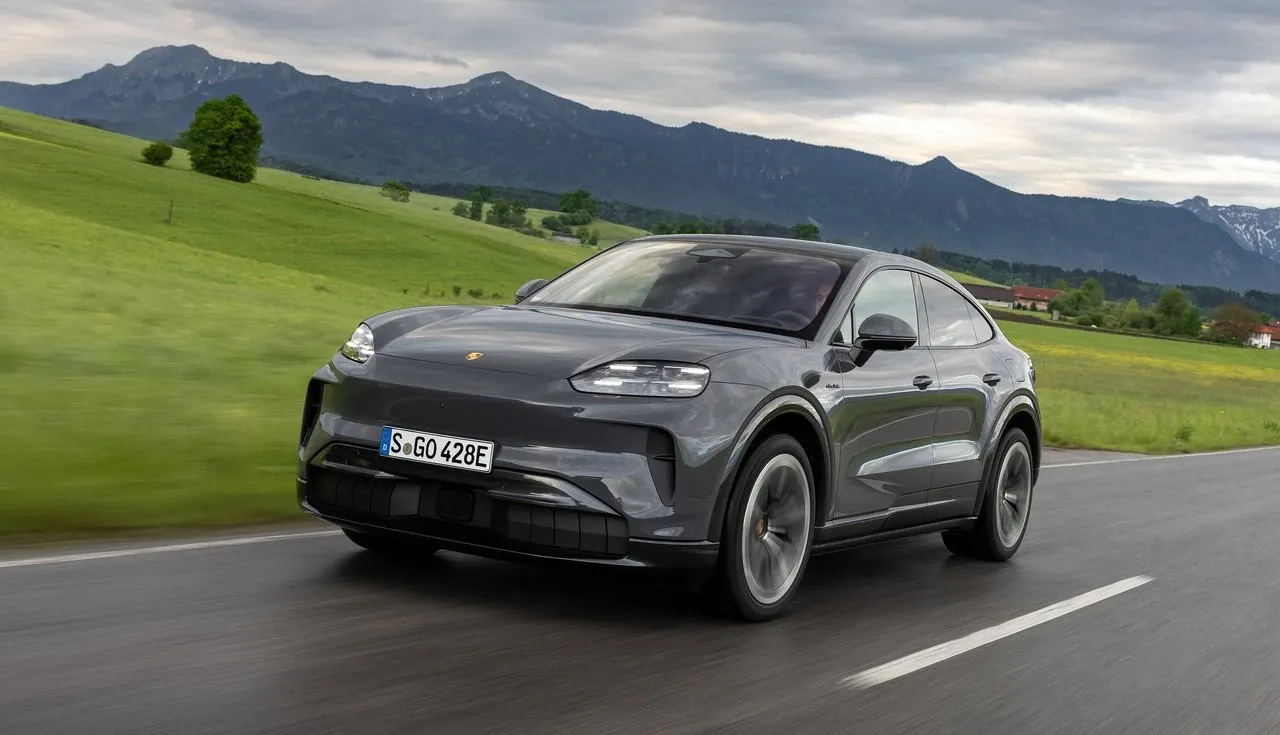
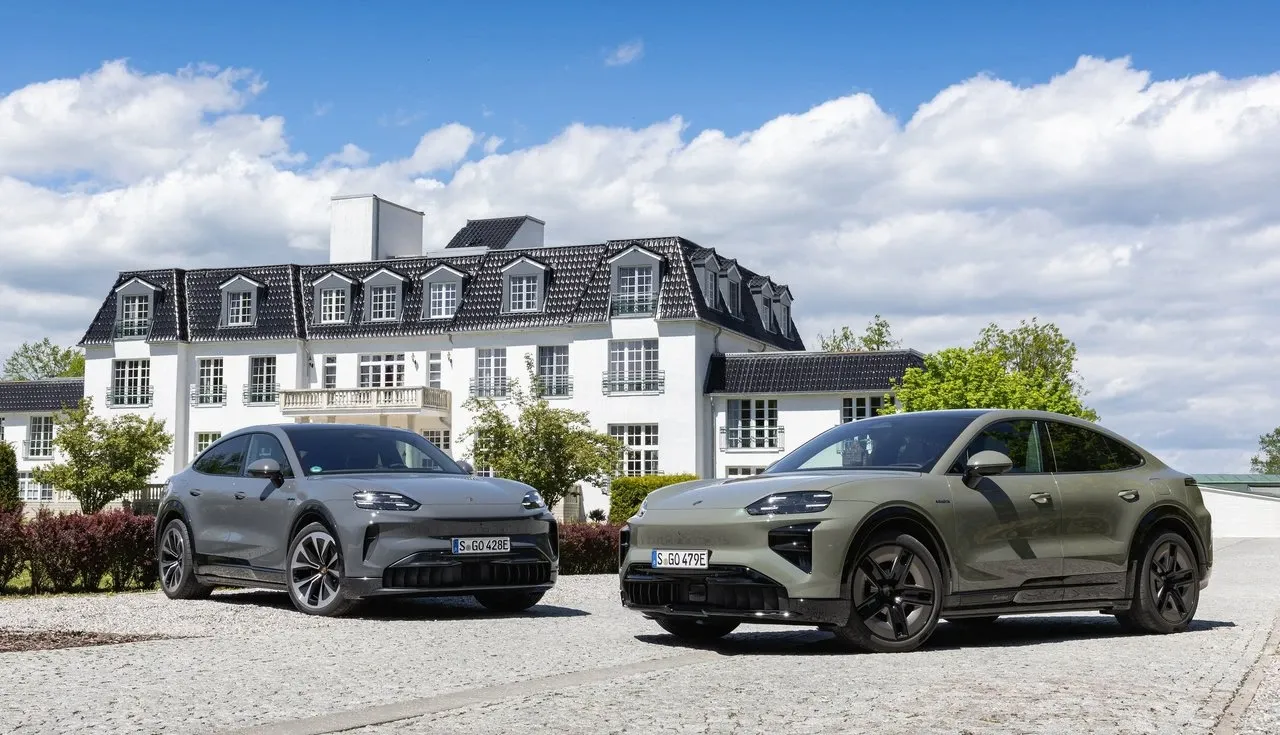
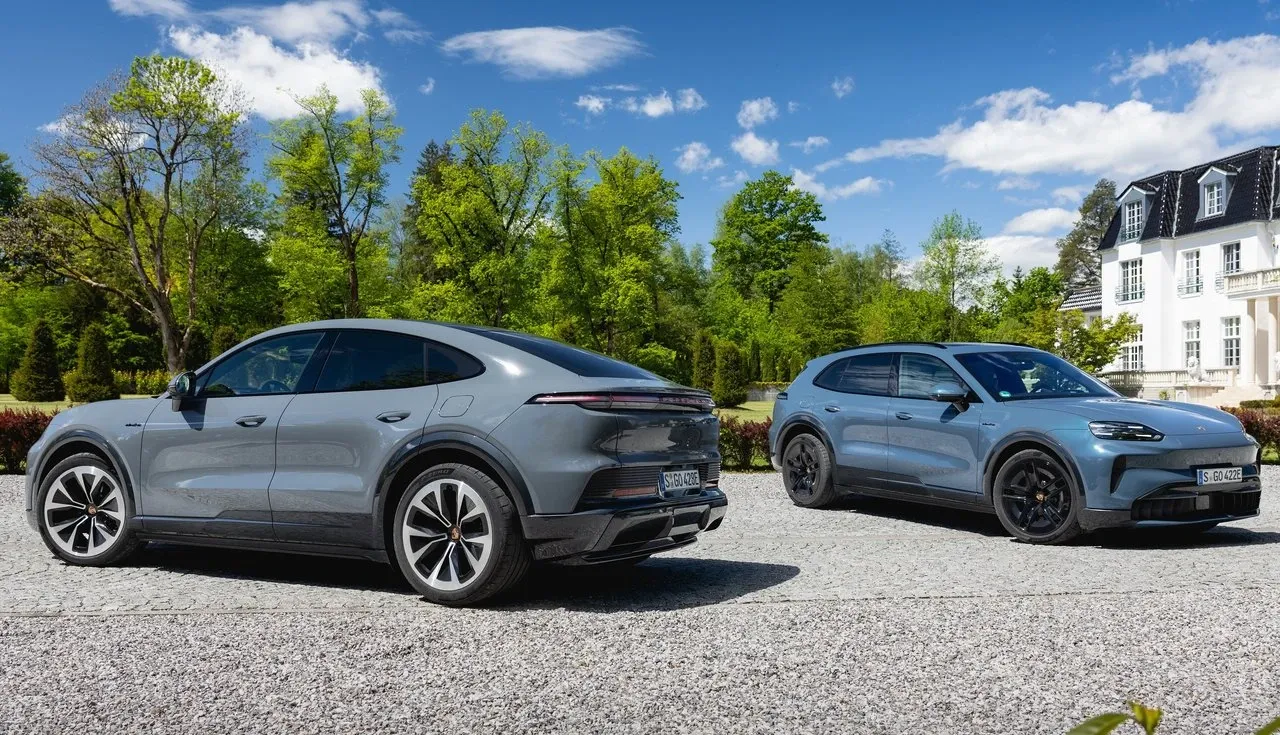
The Cayenne Coupe Electric doesn’t need to announce itself. The body carries Porsche’s signature Flyline roofline — that sharp, deliberate drop behind the B-pillar that compresses the rear end and gives the whole vehicle the stance of something coiled and ready. Up front, the nose is cleaner and more closed-off than previous generations, a direct consequence of chasing a 0.23 drag coefficient. That’s a genuinely impressive number for an SUV pushing nearly 197 inches in length.
The dimensions are substantial: 196.3 inches long, 78.0 inches wide, and riding on a 119.0-inch wheelbase. The stance feels wide and planted for the segment, with staggered wheel fitments — 255/55 up front and a noticeably wider 305/45 in the rear, both on 20-inch rims. That rear width isn’t just visual. It’s where the primary drive torque lives, and the rubber width reflects it.
Out back, a retractable spoiler sits flush in the decklid and deploys automatically above 40 mph, mechanically loading the rear axle into the pavement during high-speed runs. The taillights follow Porsche’s current horizontal design language, cleanly integrated into a rear diffuser that closes out the body with restrained aggression. The overall visual impression is purposeful without being theatrical.
Three Screens, Carbon Fiber Trim, and Zero Unnecessary Buttons
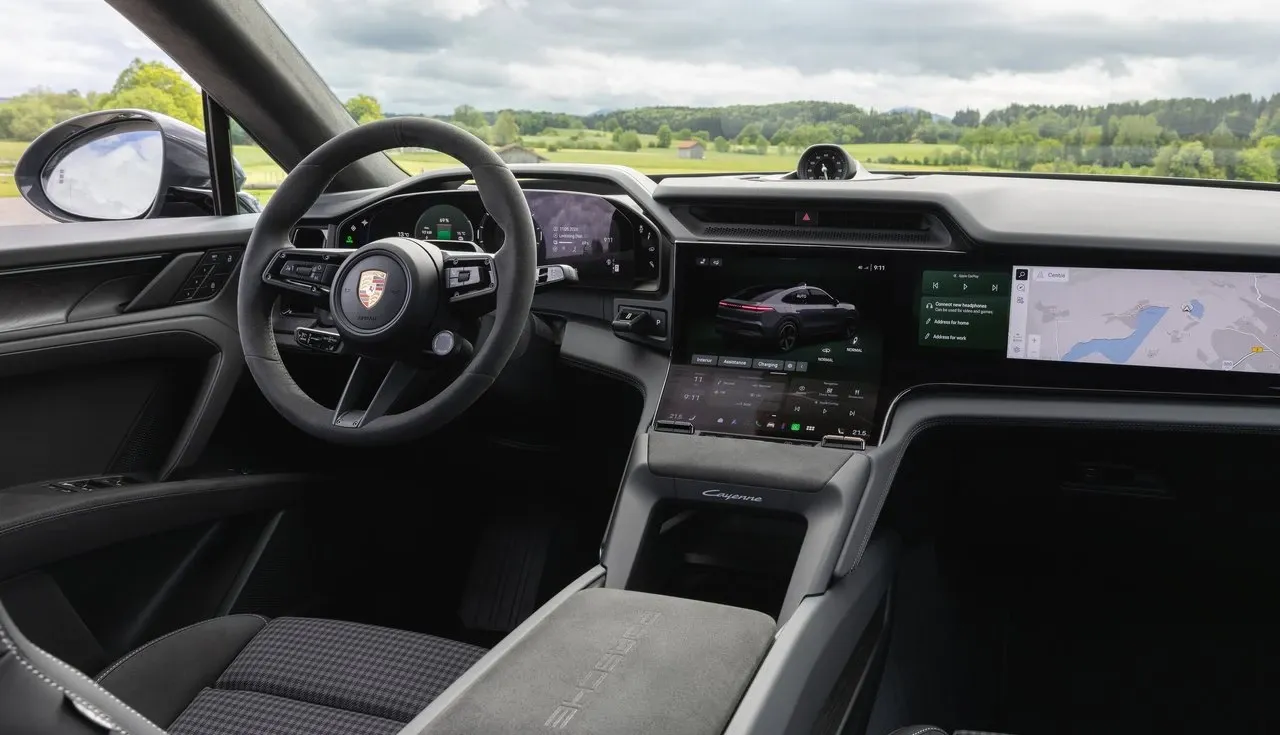
Step inside the Cayenne Coupe Electric and the cabin hits you with a specific kind of intentionality. Three independent displays stretch across the front fascia in a clean, uninterrupted sequence. The curved 14.9-inch driver display sits ahead of the steering wheel with no plastic hood overhead — Porsche relies on polarization filtering to manage glare instead. It looks sharper and cleaner than anything relying on a physical visor.
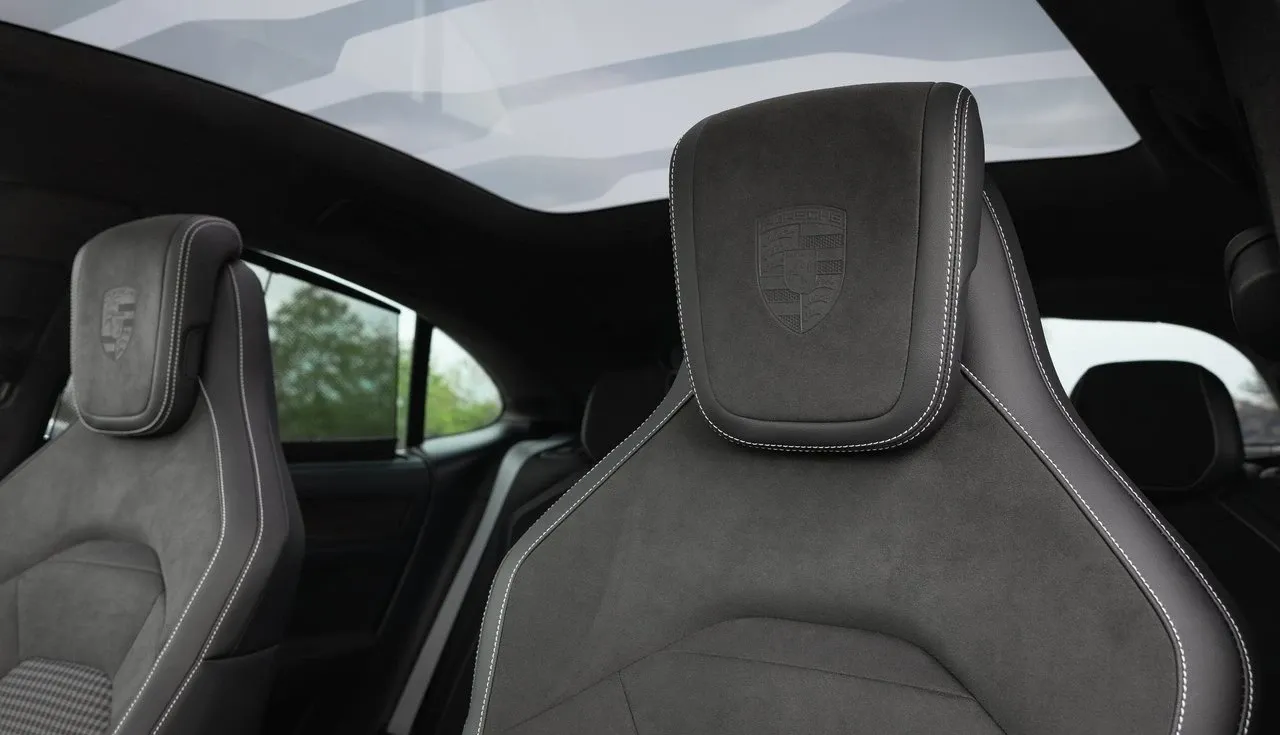
Material quality varies by trim, but even the base configuration eliminates low-grade plastics entirely. Buyers can spec everything from brushed Silverberry aluminum inserts to open-pore Elmwood wood panels. The Turbo adds matte carbon fiber trim, and the optional Lightweight Sport package swaps the panoramic glass roof for a forged carbon fiber panel, saving 38.8 lbs of unsprung mass. Interior textiles shift to high-friction Race-Tex microfiber, and the center seat backs get the retro “Pepita” houndstooth pattern — a nod to Porsche’s Le Mans heritage from the 1960s.
Infotainment, Space, and the Feature That Divides Opinions
The 12.9-inch Flow Display on the center console handles navigation, media, and trip management. But the most talked-about feature is the 14.8-inch front passenger screen, mounted on the right side of the dash. A directional privacy film renders it invisible from the driver’s viewing angle, letting the passenger stream video or pull up maps without creating a distraction hazard at highway speeds.
The real strength of this cabin is the haptic climate panel on the lower console — physical glass-touch controls for temperature adjustment that don’t require digging through menu layers. The genuine limitation is that anything beyond basic climate control still demands screen interaction while driving, which is more disruptive than traditional physical buttons would have been.
Front seats are sculpted and laterally supportive through hard corners. In the rear, the Coupe roofline extracts its price: headroom is reduced compared to the standard high-roof Cayenne, partially offset by a lower seating position. Standard seating is configured as 4+1. Cargo capacity holds at 534 liters — enough for a full set of golf bags without folding anything down.


What Happens When 1,500 lb-ft of Torque Meets Four Wheels and Open Pavement
The drivetrain in the Cayenne Coupe Electric uses two permanent magnet synchronous motors — one per axle — delivering full-time all-wheel drive with active torque vectoring. There’s no multi-speed gearbox. Power delivery is handled through single-speed direct-drive transmissions on both axles, eliminating shift lag and mechanical losses between gear changes entirely.
The lineup breaks into three distinct performance tiers. The base Cayenne Coupe Electric produces 442 hp and 616 lb-ft of torque, reaches 60 mph in 4.7 seconds, and tops out at 143 mph. It’s the most refined daily-driver option in the range and the most efficient over long distances. The Cayenne S steps up to 666 hp and 797 lb-ft, cutting the 0–60 run to 3.7 seconds with a 155-mph top speed — and for most buyers, this is the sweet spot of the lineup.
The Cayenne Turbo Coupe Electric is a different conversation entirely. In normal operation it delivers 857 hp. Pressing the Push-to-Pass button on the steering wheel adds 177 hp for 10-second intervals. With Launch Control engaged, output peaks at 1,156 hp and 1,106 lb-ft of torque, producing a 0–60 time of 2.4 seconds and a 162-mph governed top speed — in a vehicle weighing over 5,700 pounds.
The rear motor uses direct oil-immersion cooling on the stator windings, technology inherited directly from Porsche’s Formula E program, with a declared conversion efficiency of 98%. Regenerative braking peaks at the equivalent of 600 hp in reverse energy capture, substantially reducing brake wear during normal driving. DC fast charging supports up to 400 kW, filling the pack from 10% to 80% in approximately 16 minutes.
Quick Specs
| Spec | Detail |
|---|---|
| Drivetrain | Dual-motor electric AWD |
| Peak Output (Turbo, Launch Control) | 1,156 hp |
| Peak Torque (Turbo) | 1,106 lb-ft |
| Output (Standard) | 442 hp |
| Torque (Standard) | 616 lb-ft |
| 0–60 mph (Turbo) | 2.4 seconds |
| Top Speed (Turbo) | 162 mph |
| Max DC Charging Rate | 400 kW |
| Charge Time (10–80%) | ~16 minutes |
| Cargo Volume | 534 liters / 18.9 cu-ft |
| Length | 196.3 inches |
| Wheelbase | 119.0 inches |
| Curb Weight (Turbo, est.) | ~5,732 lbs |
Pricing, Ownership Costs, and Who Should Actually Buy This Thing
European and US deliveries are projected for the second half of 2026 as 2027 model year vehicles. Porsche dealerships stateside are already undergoing technical training to service the PPE platform’s high-voltage architecture — a prerequisite Porsche is treating seriously given the system’s complexity.
US pricing hasn’t been officially confirmed, but based on the model’s positioning against the iX M60 and EQE AMG 53, market estimates point to a starting figure around $105,000 for the base Cayenne Coupe Electric, approximately $120,000 for the S variant, and upward of $155,000 for the Turbo before options. These are market estimates, not confirmed Porsche MSRP figures.
Insurance will sit in the highest risk tiers across major carriers, driven primarily by the battery replacement value and high-voltage component costs. Annual premiums will vary widely depending on driver profile, location, and coverage level, but buyers should budget accordingly. On the maintenance side, the elimination of oil changes, spark plugs, and exhaust components reduces the traditional service burden significantly. The offset is tire consumption: a 5,700-lb vehicle running 305-width rear tires under sustained torque loads will cycle through rubber faster than most owners expect. If the optional Porsche Ceramic Composite Brakes are fitted and a rotor cracks, replacement cost alone can rival the purchase price of an entry-level economy car.
The purchase makes clear sense for urban and suburban drivers with home charging infrastructure already in place — a Level 2 Wallbox setup at minimum — who operate primarily on predictable routes with DC fast charging available along the way. For buyers running long rural routes in areas where fast charging infrastructure is still sparse, the E-Hybrid variants in the Cayenne lineup remain the more practical choice.
What Buyers Are Searching Before They Sign
When will the Cayenne Coupe Electric be available in the US? US deliveries are expected to begin in the second half of 2026 as a 2027 model year. Official availability dates will be confirmed closer to the European launch.
What is the real-world range of the Cayenne Coupe Electric? Porsche has not released official EPA range figures yet. Cycle estimates for the US market are expected to be published around the time of the European launch event.
How fast do the tires wear on this vehicle? Faster than average. The rear axle runs 305-width tires under more than 5,700 lbs of vehicle mass. Aggressive driving significantly shortens replacement intervals compared to lighter SUVs in this segment.
What are the main competitors to the Cayenne Coupe Electric? The BMW iX M60, Mercedes-Benz EQE SUV AMG 53, and Lotus Eletre R are the most direct rivals in the high-performance electric SUV segment.
Is the Porsche Cayenne Coupe Electric Worth the Price Tag?
For buyers with home charging, predictable routes, and a genuine appreciation for what Porsche’s engineering team built here — yes, it absolutely is. The PPE platform with oil-cooled motors and the Active Ride suspension system put this Cayenne in a technical category that no current competitor has matched. The weak point is real-world charging infrastructure, not the vehicle itself.
For long-haul rural driving, the E-Hybrid makes more sense. But the Turbo, specifically, is an emotional decision backed by legitimate engineering. There isn’t another production SUV on the planet that delivers this combination of mass, speed, and chassis refinement in a single package.
Share this article
Related posts